
You get a quote for a dental implant from your dentist back home, and then you see the number: around $3,000-$6,000 in the US, compared with roughly ₹25,000-₹60,000 in India for an implant with a crown. The difference is enough to make you look twice. But once you start looking into dental tourism in India, the questions don’t stop at the treatment price. What will the flight and hotel add? How many days will you need to stay? Is the dentist qualified? And if something goes wrong after you return home, who will deal with it?
There is a reason more attention is being given to dental travel. Grand View Research estimates India’s dental tourism market was worth about US$1.59 billion in 2025.
So, the real question isn’t simply whether treatment is cheaper. In this guide, we’ll look at the actual costs, safety checks, treatments, travel timelines, visa rules, clinic selection and aftercare, so you can work out whether the trip makes sense for your situation.
Table of Contents
Before You Book: The 8-Point Check
Don’t book a flight until you have these:
- A written treatment plan.
- An itemised quote.
- The dentist’s name, degree and registration number.
- The implant brand and crown material.
- The number of visits and total days in India.
- Your rough total trip cost.
- A follow-up plan with a dentist back home.
- Written warranty and complication terms.
New Dental Tourism Rules and Changes in India for 2026
A new dental regulator: From 19 March 2026, the National Dental Commission Act came into force. It repealed the Dentists Act, 1948 and dissolved the Dental Council of India, according to the Press Information Bureau. A new Ethics and Dental Registration Board now oversees dentist registration. The system is new, so ask any dentist for their registration number and check it.
More government focus on medical tourism in India: The Union Budget 2026-27 announced a scheme to help states build five regional medical hubs with private partners. They will include medical value tourism facilitation centres. The wider trend is real too. Government data recorded 635,000 foreign tourist arrivals for medical purposes in 2023 (provisional). That covers all medical travel, not just dentistry. The same release says implants and cosmetic work are now available in tier-2 and tier-3 cities. It also points to the Heal in India initiative.
Visa fees now depend on your nationality: More on that in the visa section.
Dental Tourism in India Cost: What You'll Really Pay?
Here’s the treatment price for one implant with a crown. If you’re comparing treatment options in Mumbai, you can also read our guide to dental implants in Mumbai to understand the procedure and what to consider when choosing a clinic.
Country | Single implant + crown |
India | ₹25,000–₹60,000 (about £200–£470) |
UK | £1,800–£3,500 |
USA | $3,000- $6,000 |
But dental tourism in India costs aren’t just the treatment. Your real number is what we call the landed cost:
Landed cost = India treatment + flights + hotel + local transport + visa + insurance + a possible second trip.
The NHS treatment abroad checklist gives the same advice. It says to factor in exchange rates, a longer stay if needed, and return trips.
A worked example
Say a USA patient needs four implants.
- At home: 4 × $4,500 = about $18,000
- In India: 4 × ₹25,000–₹60,000 = about $1,040–$2,500
- Your trip budget before savings hit zero: about $15,500–$16,960
That’s a comfortable buffer for flights, hotel, visa, insurance, and a second trip.
Now try one implant. Your home price is about $4,500, and the India price is about $260–$625. That leaves roughly $3,875–$4,240 for the whole trip. One long-haul flight can swallow much of it. A second trip may erase it.
Rates used: about ₹96 per US dollar and ₹127 per pound (late September 2026). Rates move, so recalculate with your own quotes.
Why Do Two Quotes Look So Different?
A cheap quote often covers only the implant post. Ask whether it includes the CBCT scan, abutment, crown, temporary tooth, bone graft, and follow-up visits. Two quotes only compare when they list the same parts. Also ask why prices differ. Clinic rent, lab fees, and clinician fees vary by city and country. That’s a different question from material quality, so ask which implant brand and which lab the clinic uses. See our guide to dental crown cost in Andheri West so you can understand what may be included in a crown quote.
Which Dental Treatments Are Suitable for Dental Tourism in India?
Treatment | Travel suitability | Why |
Whitening | High | Usually one visit |
Crowns, veneers | Moderate–High | Multiple visits, plus lab time |
Root canal | Moderate | Depends on infection and tooth anatomy, and it needs a crown afterwards. |
Implants | Low–Moderate | Healing and follow-up needed |
Full-mouth work | Case-dependent | Several stages |
Braces, aligners | Low | Long-term monitoring |
Expert Insight from Dr. Esha Parikh (from her root canal guide): A tooth is weaker after a root canal, so it usually needs a crown. She also says a dental microscope helps most in complicated cases, like blocked canals or large infections. For travellers, that means planning the crown visit into your trip, not treating it as an afterthought.
Is Dental Tourism in India Safe? What to Check Before You Travel
Care quality varies between clinics, in India and everywhere else. So how you choose matters more than which country you pick. Check these:
- The dentist: Ask for their degree, registration number, and how often they do your procedure. An MDS shows postgraduate training, but a BDS dentist can also do excellent work. Match the training to the job, for example, prosthodontics for complex restorations. The Indian Dental Association is the profession’s national body. Membership is a plus, but it’s not a licence.
- The clinic’s accreditation: NABH-accredited dental facilities have been assessed against standards that cover infection control, patient rights, and record-keeping. NABH accreditation lasts three years, and NABH also runs an entry-level certificate for smaller dental clinics, which is valid for two years. It isn’t mandatory, so a clinic without it can still be excellent. Registration rules differ by state, because the Clinical Establishments Act applies only where states adopted it. Just ask what registration the clinic holds.
- Infection control: The ADA reminds patients that infection-control standards differ between countries. It points to CDC infection-control guidelines as the benchmark. A study of 70 private Indian clinics found only moderate adherence to CDC-based practices, with gaps in areas like sterilisation and aerosol control. Ask your clinic how it sterilises instruments. Good clinics love that question.
- The plan, not the machines: CBCT scanners and lasers help. But they can’t replace a correct diagnosis, an honest treatment plan and a dentist who has done your procedure many times. Don’t pick a clinic because it owns the most technology.
The Plexus 7-Point Dental Tourism Decision Check
We treat dental tourism as a clinical decision first and a travel decision second. Before you fly, score yourself on these. Any “no” deserves a phone call first.
- Clinical fit: Does your dentist agree the treatment is suitable to travel for?
- Landed cost: Did you calculate the full trip, not just the quote?
- Credentials: Did you verify the dentist and their registration?
- Clinic standards: Did you ask about accreditation and sterilisation?
- Timeline: Do you know how many days and visits you’ll need?
- Home follow-up: Does a dentist back home agree to see you afterwards?
- Responsibility: Do you know who fixes a problem, and who pays?
Our view: Once your dentist confirms a treatment suits travel, dental tourism becomes a logistics problem. And the farther you travel, the more your aftercare plan matters, so plan your return before you book your flight.
How to Choose a Clinic (and Spot Red Flags)?
When people search for the best dental clinic in India, they usually mean the best clinic for their case. That’s rarely the cheapest one.
The NHS lists warning signs: a hard sell, lack of information, pressure to decide quickly, no talk of complications and no mention of aftercare. Walk away if you see any of them.
Many clinics sell dental tourism packages in India. A good one lists treatment, airport pickup, hotel help and follow-up visits. A weak one hides what’s missing. Ask for the package in writing, and ask about a plan-change clause. If the dentist finds bone loss or infection once you arrive, who approves extra work and extra cost? Get that answer before you fly.
Send your records first: X-rays, any CBCT scan, medical history, medication list and allergies. A good dentist will review them and give you an honest opinion. Sometimes that opinion is “don’t travel for this.”
What We See in Practice: Planning Mistakes to Avoid
In our experience, the biggest planning mistake isn’t picking the wrong city. It’s booking flights before checking whether the treatment fits into the time they actually have.
A few others we see often:
- Comparing quotes that don’t include the same things, like the scan, crown or follow-up visits.
- Planning for the root canal but not the crown visit that should come after it.
- Sending X-rays late, so the plan changes once they’ve already landed.
- Leaving without a dentist back home who’s agreed to see them afterwards.
What Are The Top Dental Tourism Destinations in India?
Choose the dentist first and the city second. Still, these are the top dental destinations for international patients:
- Mumbai: A major international gateway with a large private healthcare sector and extensive direct and connecting flight options.
- Delhi NCR, Bengaluru, Hyderabad and Chennai: strong hospital networks and international flight links.
- Smaller cities: the government says implants are now available in tier-2 and tier-3 cities. Prices there can run lower, but flight connections may add a domestic leg.
Dental tourism in Mumbai has a practical edge. Andheri West sits on the airport side of the city, so transfers stay short. Mumbai also has a second airport. Navi Mumbai International Airport started commercial operations on 25 December 2025. For long-haul routes, check which airport your flight actually uses before you book a hotel.
We’re in Lokhandwala, Andheri West. dental clinic in Andheri West, Plexus Dental Studio was founded in 2014 and works with a dental microscope, lasers, and digital workflows.. Our root canals range from ₹3,000 to ₹15,000 (about $31 to $156), done by an endodontist. Check our current price when you enquire.
How Long Should You Stay in India for Dental Treatment?
Treat these as planning estimates. Your dentist sets the real schedule.
Treatment | Typical time in India |
Whitening | One visit |
Root canal | 1–3 visits |
Crown or veneers | Around 1–2 weeks |
Implants | Often two trips |
Full-mouth work | Case-dependent |
Implants usually need two trips: Trip one covers your scan, plan, any extraction or bone graft, and implant placement. Then you heal at home. NHS trust guidance says implants are usually left to bond with the bone for 2-6 months before use. Trip two covers scans or impressions, the final crown, a bite check and a review.
In addition, the NHS also says to stay in the country long enough to recover before flying home. Keep sightseeing for after treatment, and keep follow-up appointments fixed.
Visa Rules for Dental Tourism in India in 2026
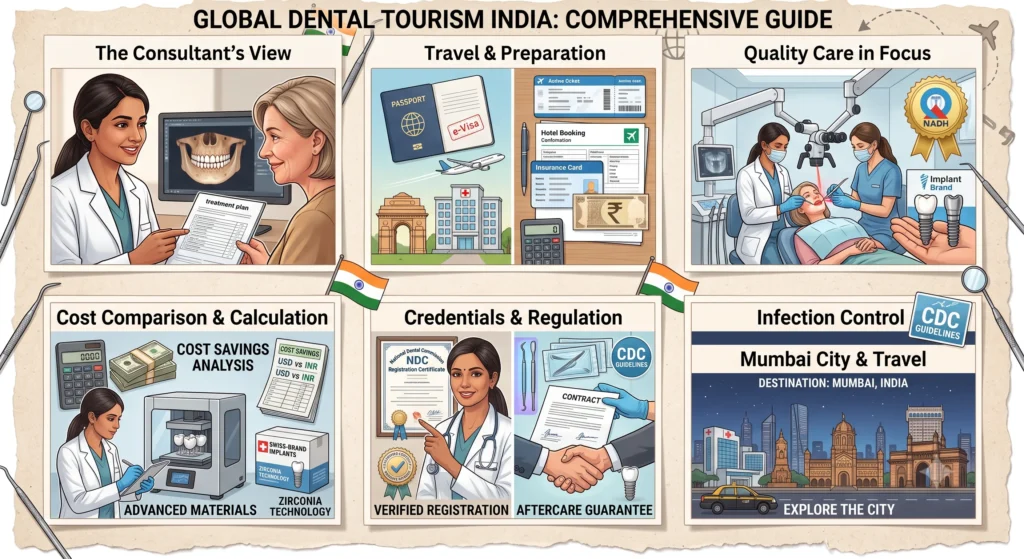
Use the official Indian e-Visa portal. Copycat sites charge extra.
- e-Medical Visa: valid for 60 days from first arrival, with multiple entries during that window. It can’t be extended or converted.
- e-Medical Attendant Visa: for a companion, on the same validity. Each person applies separately.
- Fees depend on nationality. The official fee schedule, dated 15 April 2026, lists e-Medical fees of $100 for US citizens, $129 for UK citizens and $80 for Canada and Australia, plus a bank charge. Check your own country’s line before you pay.
If your treatment might outlast 60 days, ask your clinic and the nearest Indian mission about a regular medical visa instead. Rules change, so check the portal on the day you apply.
After You Get Home: Your Aftercare Passport
You should ask the Indian clinic to hand you an “aftercare passport” before you leave:
- Your implant brand, model, size and batch number, if available.
- X-rays and CBCT scans in a file you can open.
- Clinical notes, invoices and your signed consent forms.
- The crown material and which lab made it.
- Written warranty terms, including what they exclude.
- Care instructions and an emergency contact number.
Then arrange follow-up care with your home dentist before you travel. The ADA advises confirming that your insurer covers follow-up on your return, and checking that cross-border record transfers meet your country’s privacy rules. The British Dental Journal also advises collecting all records, X-rays and consent forms.
Keep your expectations honest, too. A 20-year review concluded that follow-up shouldn’t end after placement, or even after year ten. So a good result depends on care after you land, not just on the surgery.
Finally, sort out who pays if a problem appears. Ask the clinic whether it will coordinate with your local dentist and whether it covers a corrective visit.

When Dental Tourism Doesn't Make Sense?
Skip it for fillings, cleanings, and small jobs. Airfare and a hotel wipe out the savings. Be careful with anything that needs monthly checks, like braces. Also think twice if you can’t take enough time off, or if no dentist at home will see you afterwards.
It’s worth investigating for multiple implants, full-arch work, several crowns, and large cosmetic cases. Other countries compete for these patients too, so compare total cost, flight time and follow-up options before you decide.
Dental Tourism in India: What You Should Think About Before You Fly
If you’re considering dental tourism in India, don’t make the decision based on the treatment price alone. Add your flights, hotel, visa, time in India, and the possibility of a second trip. More importantly, know who is treating you and what happens if you need help after you get home.
For patients considering Mumbai, Plexus Dental Studio can discuss the treatment plan and help you understand what the process may involve. Take your time, ask questions, and get everything in writing before you book your flight.
Disclaimer: This guide is general information, not medical advice. Your own dentist should confirm whether your treatment suits travel.
