
Many parents believe that their child only needs a dental checkup once their permanent teeth begin to erupt or when a visible cavity appears. However, dental care should begin much earlier. An early dental visit helps identify potential risks of tooth decay, establish healthy oral hygiene habits and educate parents on how to care for their baby’s developing teeth and gums. It also allows the dentist to monitor tooth eruption, assess jaw development and identify any early signs of dental abnormalities.
Parents can also receive guidance on feeding practices, fluoride use and preventive dental care to protect their child’s growing smile. Starting dental care early lays the foundation for a lifetime of healthy smiles.
Table of Contents
When Should Your Baby Have Their First Dental Visit?
It is recommended that your child’s first dental visit should be:-
- Within 6 months after eruption of the first tooth
- By the time the baby reaches 12 months of age (first birthday)
Whichever of the above comes first.
An early dental checkup with a trusted dentist in Andheri West helps parents understand how to maintain their child’s oral hygiene, educate you on the importance of milk teeth and help you recognize any oral habits that can harm their dental development.
Your dentist helps you understand the timeline for primary tooth eruption and at what age can you expect its further replacement with permanent tooth.
Why Is an Early Dental Visit Important?
An early dental visit helps the dentist recognize any harmful habits and existing cavities. Harmful oral habits like thumb sucking, tongue thrusting, nail biting and mouth breathing disrupts the normal dental and jaw development thus resulting in malaligned teeth and abnormal bite.
Early detected caries or dental anomalies can be treated with less invasive options, less treatment cost, minimal pain and provides a long-term good prognosis.
What Happens During Your Baby's First Dental Visit?
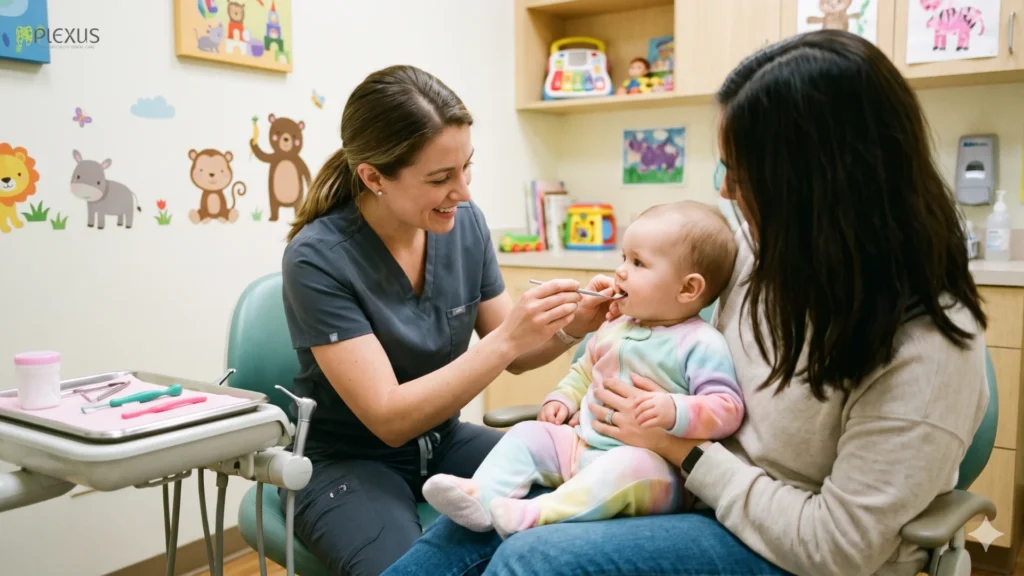
A baby’s first dental visit is not the same as an adult’s first visit. During your baby’s first visit, the dentist and the clinic usually tries to create a friendly environment for the baby, where they feel safe. A person’s fear of dentists can be rooted from a bad dental experience during childhood.
Therefore it is very important that the baby’s first dental experience is as comfortable as possible. Regular visits to a children’s dentist help monitor tooth eruption, assess oral development and establish preventive dental care habits.”
The dentist will perform the following procedures during the first visit:-
- Assessment of teeth,tongue, gums and surrounding oral tissues like lips and cheeks
- Examination of tooth eruption and enamel.
- Caries risk assessment
- Evaluation of feeding and oral hygiene habits
- Recommendation of caries prevention measures like fluoride varnish whenever indicated
Common Dental Problems in Babies
Early Childhood Caries (ECC) :-
ECC is the presence of one or more decayed, missing or filled teeth in children aged 5 or younger.
Natal and Neo-natal Teeth:-
Natal and Neo-natal teeth are present very early in an infant’s life. Natal teeth are teeth that are present in the mouth at birth. Neo-natal teeth are teeth that erupt within 30 days of life.
Delayed Tooth Eruption:-
Baby teeth coming in late can be due to multiple reasons like nutritional deficiencies, genetics, premature birth and developmental disorders. Delayed tooth eruption does not require any specific treatment but a dental checkup is still recommended if the child reaches 12 months of age without teeth.
Enamel Defects:-
Enamel defects in children occur when the outer enamel surface is not formed or mineralized properly. Such hypomineralized teeth have poor strength, have high risk for caries and cause cosmetic concerns during staining.
How to Care for Your Baby's Teeth at Home?
- Parents need to practice maintaining their kids’ oral hygiene even before the first tooth erupts. Use a clean soft washcloth to wipe milk and food particles from the gums, ridges and tongue.
- Once the first tooth erupts, brushing should be introduced. The primary diet of a baby may predominantly consist of milk which can contribute to early childhood caries. Therefore, brushing the tooth surface is important.
- It is important to know about the age- appropriate brushes for your baby’s teeth.
Here’s a chart that can help you understand the type of toothbrush that needs to be used :-
AGE | TOOTHBRUSH TYPE | PARENTAL SUPERVISION |
0-3 YEARS | Finger slip silicone toothbrush or an infant to toddler toothbrush with tiny head and soft bristles | Parents must do the brushing |
3-5 YEARS | Small-headed, soft bristle manual toothbrush with pea-size toothpaste | Children can try brushing independently under parental supervision or rebrushing |
6-9 YEARS | Junior manual or small electric soft bristled toothbrush with built-in timer | Parental supervision advised till age 8 |
10+ YEARS | Adult-sized manual or electric toothbrush with soft bristles | No supervision required. Children should independently brush twice a day for 2 mins along with flossing. |
Common Myths Parents Have About Baby Teeth
Milk Teeth Are Temporary, So Cavities Don’t Matter
Parents usually ignore their baby’s milk teeth thinking that they will soon be replaced by permanent teeth.
Premature loss of primary teeth due to decay can affect the space for permanent teeth. Deficient space during eruption of permanent teeth can lead to crowding and malaligned teeth in future.
Tooth decay in babies if left untreated can severely affect their quality of life. A decayed tooth can lead to difficulty in chewing food,poor sleep quality and inability to pay attention in school due to pain. In severe cases it can cause bacteria infection along with swelling. The need to treat a particular tooth depends on the age of the child and the tooth in question.
When our kid patients visit us with complaints of decayed teeth, the first assessment done at plexus studio is to check their age to get an idea whether the primary tooth is near exfoliation or not. If the tooth is going to fall out soon then it can be kept under observation to let it fall on its own.
No Pain Means No Cavity
It is not necessary that every decayed tooth will cause pain. Many long standing decayed or infectious teeth are non-symptomatic. But the disease keeps on progressing and can cause more harm later. Preventive or early treatment is better, less painful and cost efficient in the longer run.
Teething Causes Fever
No teething is not responsible for high fever, diarrhea,cough or nasal congestion. The common symptoms that usually occur while teething are drooling, gum irritability, trouble-sleeping and urge to chew on objects

