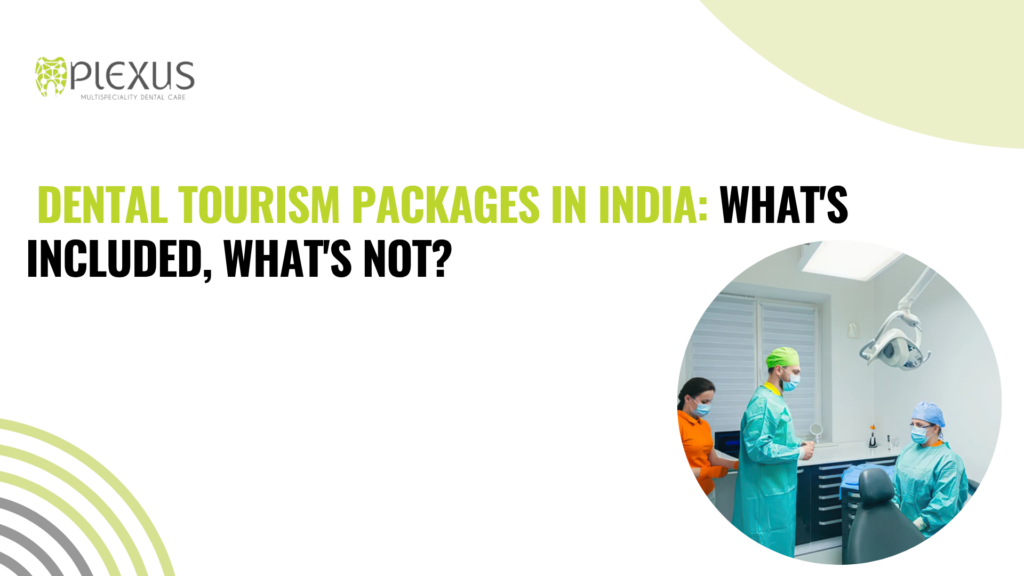
You see a dental tourism package for ₹2 lakh and think, “That’s actually not bad.” Then you start reading the fine print. The flight isn’t included. The hotel is only for three nights. Your scans cost extra. And if you’re getting an implant, you might have to come back months later for the final crown. Suddenly, the deal doesn’t look quite as good.
That’s the problem with dental tourism packages in India. “All-inclusive” can mean very different things from one clinic to another. One package may include treatment, a hotel and airport transfers. Another may cover little more than the dental work itself. So instead of looking at the advertised price, you need to work out what the whole trip will actually cost.
In this guide, we’ll look at what these packages usually include, what you may have to pay extra for, and what to check before booking.
Table of Contents
What Are Dental Tourism Packages in India?
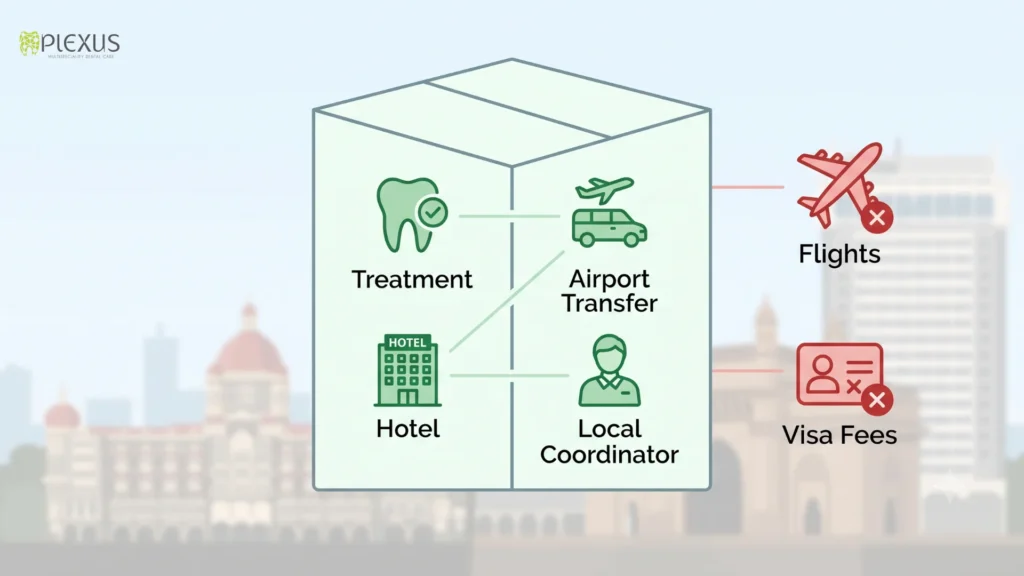
A dental tourism package bundles dental treatment with travel help. It usually covers a consultation, the treatment, and often an airport transfer, a hotel stay, and a coordinator. Flights and visas are almost always separate. What counts as a “package” changes from clinic to clinic.
India’s tourism ministry estimates that 507,244 foreign nationals arrived specifically for medical treatment in 2025, about 5.5% of all foreign arrivals. That number covers all treatment, not only dental. Dental care is on the government’s list, though.
Dental tourism in India pulls patients from the US, UK, Canada, Australia, the Gulf, and many NRIs. Mumbai, Delhi NCR, Bengaluru, Hyderabad, and Chennai are common choices.
If you pick dental tourism in Mumbai, check how far your hotel is from the clinic. City traffic can eat your day.
Some clinics sell dental holiday packages that add sightseeing too. Treat that as a bonus. Treatment comes first, and a long tour right after surgery is a bad idea.
What's Usually Included in a Dental Tourism Package?
These are the usual package inclusions. Check the details, because the same word means different things at different clinics.
- Pre-arrival consultation: You send X-rays and your dental and medical history. The clinic shares a draft plan and an estimate, usually over video. The estimate can change after the in-person exam.
- Diagnostics: Expect an exam and X-rays. A 3D scan (CBCT) is added when your case needs it, mostly for implants. Not every patient needs every scan.
- Treatment: Only the procedures written in your quote are covered. “Implant” may mean just the titanium post, with the abutment and crown billed separately.
- Airport transfer: Check whether it is one-way or return, private or shared, and whether hotel-to-clinic transportation are included.
- Hotel: Check the number of nights, category, breakfast and distance to the clinic The room of a companion is often priced separately.
- Coordinator: This person books appointments, helps with language and fixes small difficulties while you are there.
- Medicines and aftercare: Some packages include basic prescriptions and written aftercare steps. Others don’t.
- Follow-up: Good clinics offer video or WhatsApp check-ins.
Expert tip from Dr. Esha Parikh, Endodontist, Plexus Dental Studio: Ask what happens to your records. You should leave with digital X-rays, scans, and a written summary of every tooth treated. Your dentist at home will need them.
What's Usually NOT Included (The Hidden Costs)
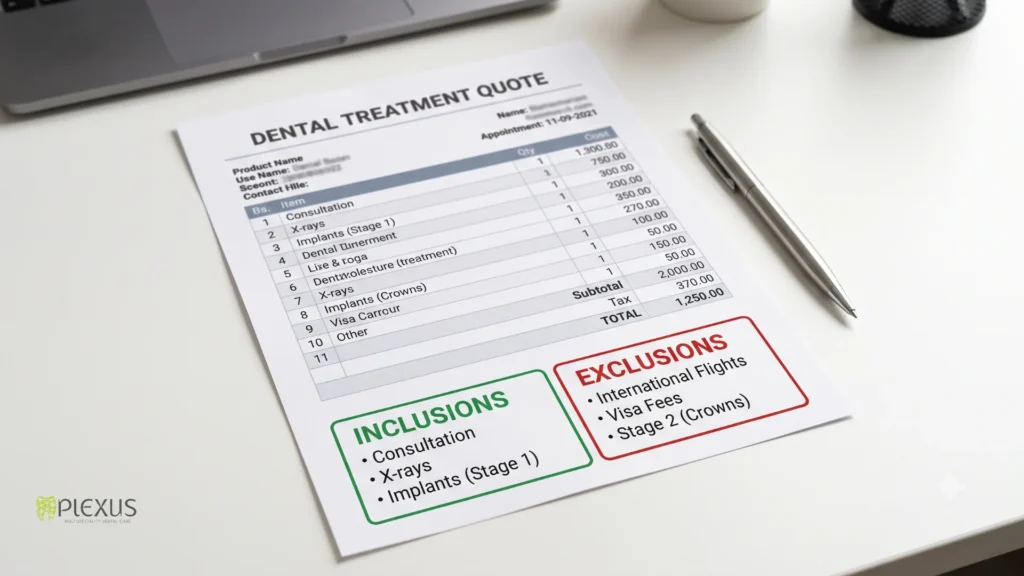
This is where hidden dental tourism costs in India show up. Most packages leave these out:
- International flights: Almost always separate.
- Visa fees: See the visa note below.
- Travel insurance: Standard policies often exclude planned treatment, so check yours.
- Meals and personal spending: Beyond breakfast, you pay.
- Companion costs: Their flight, room, and food.
- Extra tests and treatment: A bone graft, sinus lift, or extraction may turn up after the scan.
- Extra hotel nights: Delays and healing days add up fast.
- Emergency care: Unplanned treatment is rarely covered.
- A second trip: Common with implants (more on that below).
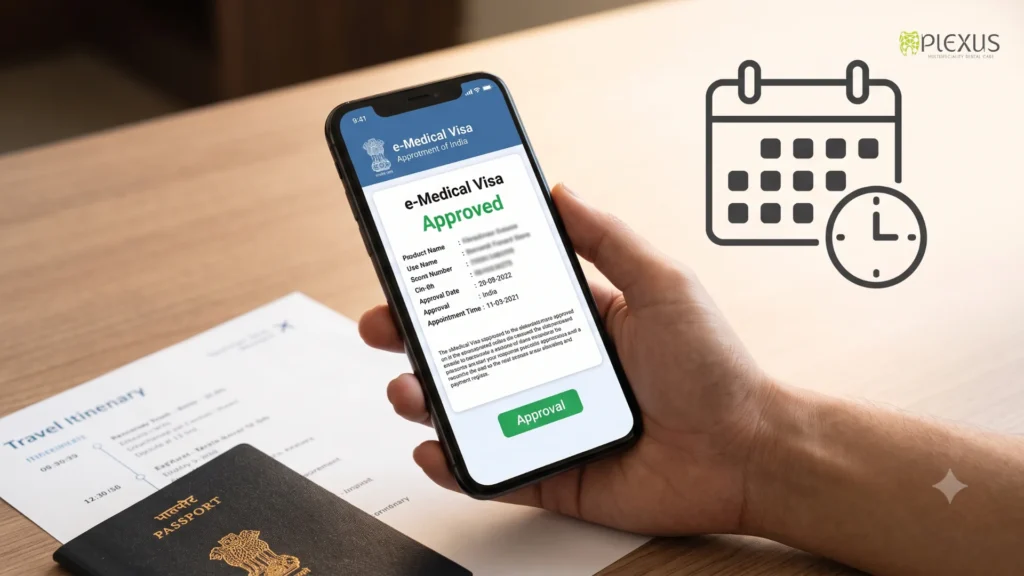
Visa note: India runs an e-Medical visa for treatment. Government information published in 2026 says e-Medical and e-Medical Attendant facilities have been extended to 172 countries. Eligibility can change, so check the current official list before applying. e-Medical visa is valid for only two attendant visas and you are required to apply online at least four days prior to arrival. As a rule the visa is for 60 days triple entry and normally requires supporting documentation from the treatment clinic.
When applying for the e-Medical visa you have to upload a letter from the Indian facility with tentative treatment dates. Fee and regulations subject to change and will differ according to nationality. Check the official Indian e-Visa portal before you buy flights. Don’t assume a tourist visa covers treatment.
Never assume “all-inclusive” means every expense from leaving home to returning home is covered. Ask for a written list of inclusions and exclusions.
What Are The Types of Dental Tourism Packages?
Not every trip looks the same. Use this as a rough planning guide. Your dentist sets the real schedule.
Package type | Time in India | Good for | Watch for |
Routine care | A few days | Cleaning, fillings, root canal | Flights can wipe out the saving |
Cosmetic | About 1–2 weeks | Veneers, crowns, whitening | Lab time, temporary teeth |
Single implant | May require two visits, often months apart | One missing tooth | Abutment and crown billed separately |
Full-arch or full-mouth | Often staged over visits | All-on-4, all-on-6, rehabilitation | Extra procedures, healing time |
If you’re comparing different dental tourism destinations, consider treatment availability, travel time, accommodation, local transport, and access to follow-up care—not just the advertised treatment price.
Are Dental Tourism Packages Really "All-Inclusive"?
Rarely. An all-inclusive dental package usually means treatment, a transfer, and a hotel. Here is what to expect and what to ask.
Package item | Typical in packages? | What to ask |
Consultation | Yes | Online or in person? |
Treatment | Yes | Exact procedure, brand, crown type |
X-rays / CBCT | Often | Which scans? |
Airport transfer | Often | Both directions? |
Hotel | Varies | How many nights? |
Meals | Varies | Breakfast only? |
Medicines | Varies | Which ones? |
Follow-up | Varies | Video or in person? |
Flights, visa, insurance | No | Does the clinic help with visa papers? |
Extra treatment, extra nights | No | Price per item |
Second trip | No | Is it required? |
How Much Do Dental Treatment Packages in India Cost?
It depends. Price changes with the procedure, number of teeth, dentist, materials, implant brand, city, and exchange rate.
Use this formula for a package cost breakdown:
Effective trip cost = package price + flights + visa + insurance + food and personal spending + extra nights + likely extra treatment + second trip (if needed)
Prices of dental work in India vary a lot, even inside one city. These are asking prices published on clinic pages in 2026, not market averages. A Delhi clinic puts a single implant at ₹25,000 to ₹45,000, usually with abutment and crown. A Navi Mumbai chain lists implant plus crown at ₹50,000 to ₹80,000. For All-on-4, directory listings run from about ₹1 lakh to ₹6.5 lakh per arch. A gap that wide usually comes down to brand, materials, and technique.
Dental implant tourism in India is where the savings are biggest. It’s also where packages get complicated. When you compare dental tourism packages 2026, look at the whole trip, not the treatment line alone.
A worked example
These numbers are made up to show the method. They are not real quotes.
Cost | Package A | Package B |
Treatment | ₹2,00,000 | ₹2,30,000 |
CBCT scan | ₹8,000 | Included |
Abutment and crown | ₹40,000 | Included |
Extra hotel nights | ₹15,000 | Included |
Total so far | ₹2,63,000 | ₹2,30,000 |
Second trip | Required | Not required |
Package A looked ₹30,000 cheaper. It ends up ₹33,000 more expensive, and you haven’t paid for the second flight yet.
Note: Most clinics quote in INR but may show values in USD/GBP/EUR. Please confirm if you can pay with an international card or bank transfer. Also verify with your bank about their foreign transaction fees. Never pay 100% up front unless the clinic has a good verifiable review history and clear terms for refunds.
Will You Need a Second Trip for Dental Implants?
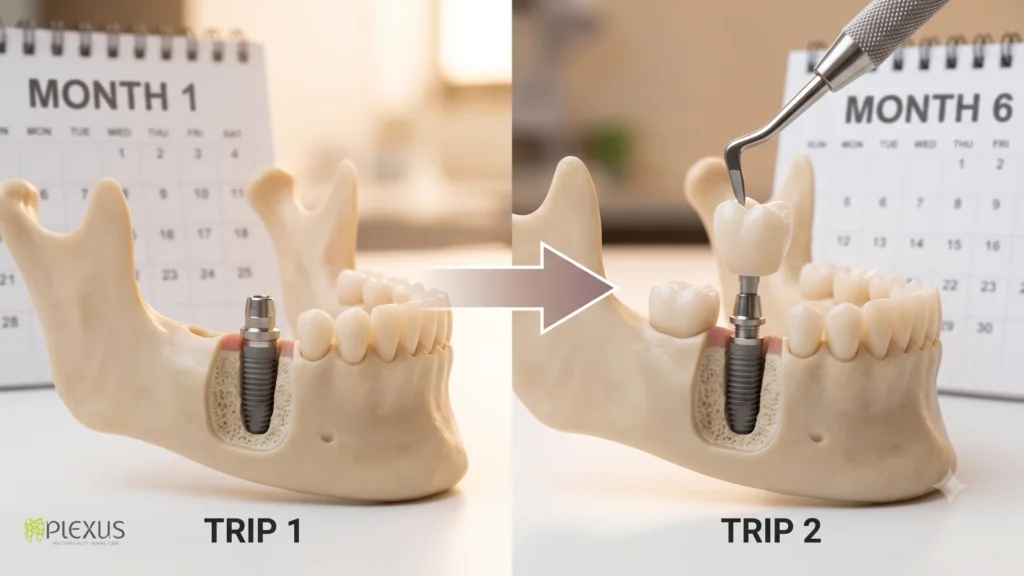
Often, yes. Simple work like crowns, veneers, whitening, and root canals can usually finish in one trip. Your dentist decides the real timeline.
Implants work in stages. The implant goes in first. Then the bone heals around it, a process called osseointegration. The American Dental Association says this takes time: some patients wait up to several months before replacement teeth are attached, while others can have the implants and teeth placed in one visit.
Most conventional implants require two brief trips. One for insertion (3-7 days) and one (3-6 months later) for the final crown (3-5 days). The ADA also notes that tobacco use can slow healing.
So ask this one question: “Is this package built for one trip, or do I return for the final crown?” The flights and hotel for a second trip are almost never at the first price.
Expert tip from Dr. Esha Parikh, Endodontist, Plexus Dental Studio: Before you agree to an extraction and an implant, ask if the natural tooth can be saved with root canal treatment and a crown. Saving a tooth can mean less surgery. A good treatment plan should explain why a tooth can’t be saved.
The Home-Dentist Handover: A Step Most Guides Skip
Here is the part nobody puts in a brochure. After you fly home, your local dentist will do your check-ups and handle any problems. They can only help if they know exactly what was done.
The UK’s General Dental Council also advises patients to talk to their own dentist before travelling abroad. Do that. It’s a free step that most patients skip.
Before you leave India, ask the clinic for a handover file:
- A treatment summary with dates and tooth numbers.
- Implant brand, size, and any implant ID card the system provides.
- Digital X-rays and CBCT files.
- Crown or veneer material and the lab used.
- Medicines and anaesthesia notes.
- Written warranty terms.
- An aftercare plan with check-up dates.
- A clinic emergency contact, with hours in your time zone.
Know the warning signs. Contact the clinic and your local dentist if you notice swelling that spreads, fever, pus or a bad taste, a bite that feels off, a loose crown or implant, numbness that doesn’t fade, or bleeding that won’t stop. Go to emergency care if you have trouble breathing or swallowing.
What Your Written Quote Should Say
Ask for an itemised quote that lists:
- Procedure and number of teeth.
- Dentist’s name and registration number.
- Implant brand and model, abutment, and crown material.
- Temporary teeth, if needed.
- Scans and diagnostics.
- Anaesthesia or sedation.
- Medicines.
- Hotel and number of nights.
- Airport transfer and local transport.
- Follow-up plan.
- Prices for extra treatment and extra nights.
- Warranty terms and who pays for corrective treatment (e.g., what’s covered, for how long, and whether you must see a local dentist for regular check-ups to keep it valid).
- Cancellation and refund terms.
- Number of trips needed.
How to Check a Dental Clinic in India?
A pretty website tells you nothing. Check these instead.
The dentist’s registration: India launched a National Dental Register in February 2024. It gives every practising dentist a unique ID after verification by the state dental council, and it helps citizens identify verified dentists. Ask for the dentist’s ID. If the clinic hesitates, that tells you something.
Qualifications: For implants or complex work, look for a postgraduate degree (MDS) in the right field. The Indian Dental Association membership is not a licence, but it’s a useful extra signal.
Accreditation: NABH is India’s hospital quality body. The government says it is strengthening NABH accreditation for hospitals, wellness centres, and dental clinics. Many good clinics aren’t accredited yet, so ask, but don’t treat it as the only test.
Infection control: The CDC’s dental sterilisation guidance says reusable instruments need cleaning and heat sterilisation, and sterilisers should be checked with biological indicators. Ask the clinic one plain question: “How do you test your sterilizer?” A confident answer is a good sign.
The middleman: If a facilitator books your trip, check who they are. The government is encouraging the registration and rating of medical travel facilitators.
Expert tip from Dr. Esha Parikh, Endodontist, Plexus Dental Studio: Ask to see the sterilisation area, or a photo of it. A tidy, organised setup tells you more about a clinic than its waiting room does.
What Are The Red Flags You Should Watch For?
- A price far below every other quote.
- “All-inclusive” with no itemised list.
- No dentist name or registration number.
- Guaranteed results or very short timelines.
- Pressure to pay everything before you land.
- No written cancellation, warranty, or complication policy.
- No clear answer about a second trip.
Is Dental Treatment Abroad Worth It?
For big work like implants, multiple crowns, or a full-mouth case, the savings can be real. For one filling or one crown, flights and hotels may cancel out the savings.
The risks are real too. Follow-up is harder from another country. The ADA puts it bluntly in its travel guidance: money saved overseas can turn into a bigger expense for your health and your wallet back home. We suggest you talk to your primary healthcare professional well before you travel, and consider a travel medicine specialist 4-6 weeks ahead.
So the honest answer is: it works for some patients, with a clear plan, a registered dentist, and a total cost you’ve calculated. It doesn’t work for people who book on the headline price alone.
Dental Tourism Packages: Check the Full Picture Before You Book
Dental tourism packages can save you money, but only when you know what you’re actually paying for. Don’t stop at the package price. Check the treatment, scans, hotel nights, transfers, extra procedures, and whether you’ll need another trip. It’s also worth asking what happens once you’re back home. Clinics such as Plexus Dental Studio can be considered as part of that research, but the same questions should be asked wherever you go. Get everything in writing, check the dentist’s credentials, and make sure the plan makes sense for your treatment before you book.
Disclaimer: This article is for general information. It isn’t a substitute for advice from a dentist who has examined you.