What Are Braces And Why Are They Needed?
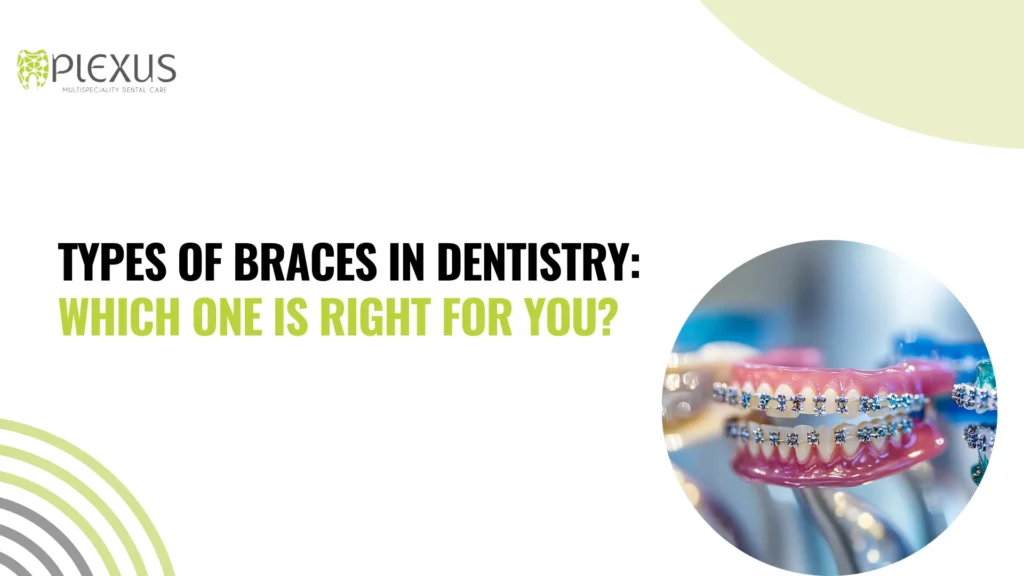
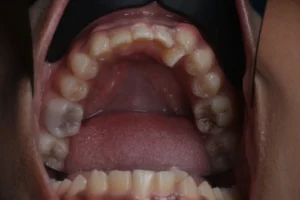
With advancements in modern dentistry, there are now multiple options available to straighten teeth making orthodontic treatment suitable for children, teenagers, and adults alike. The different types of braces available today are designed to suit varying dental needs, lifestyles, and aesthetic preferences. Braces are traditional metallic devices worn over teeth to help straighten them. You must’ve seen lots of teens and young adults with braces on their teeth. These devices just help to shift the teeth naturally. Different types of Braces can help correct teeth concerns such as:
1. Crowded teeth
2. Gaps between teeth
3. Deep bite or cross bite
4. Faulty Jaw positioning
What Are the Different Types of Braces Available Today?
In today’s era, we have a lot of options available for correcting teeth- right from young kids to braces for adults! These different options are based on 2 types:
Fixed: bonded to your teeth
Removable: can be removed
Types of Braces
Metal Braces (metallic in colour)
Aligners (transparent)
Ceramic Braces (white in colour)
Palatal / Lingual Braces (metallic in colour)
Different Types of Braces Based on How They Are Worn
Fixed Braces (Metal or Ceramic)
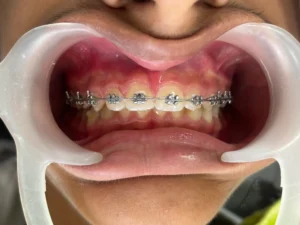 Fixed Braces (Metal or Ceramic)
With Fixed braces- either metal or ceramic- the wires are bonded onto your teeth and require a visit to the dentist every month, to get the wire tightened.
Metal Braces
These are metallic wires bonded onto your teeth. They are quite visible and require a few weeks to get accustomed to the metallic components. The effectiveness of metal wires is very good, and they are recommended for young kids who are not concerned with appearance.
However, there is significant restriction in food as the patients are suggested not to bite into hard food- eg. chips, nachos, etc- as they can lead to breakages in the wire. The only advantage of metal braces is that they keep doing the movements of the teeth irrespective of the patient’s co-operation. Duration of braces usually last for 1-2 years depending on how much correction of teeth is required.
Ceramic Braces:
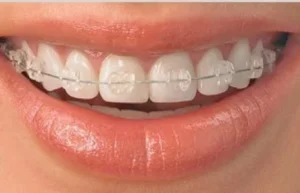 These are very similar to the metal braces in terms of adaptability, effectiveness, restrictions on diet. The only advantage of ceramic braces are-they are white in colour , due to the ceramic- which makes them less visible from a distance compared to metal braces.
These braces are usually preferred by teenage female patients who might be conscious of their appearance with their braces on.
However, with Indian food, the ceramic braces tend to discolour over time and may eventually get a slightly yellowish appearance.
Palatal/ Lingual Braces:
These are usually metallic braces which are bonded onto the inner surface of your teeth- this has good aesthetics because the wires are almost not visible from outside.
However, they tend to have a longer adaptation period, and patients may frequently get cuts/ ulcers in their tongue and it can also affect the speech.
These are slightly less efficient than the regular type of braces- due to the placement and are only possible in a select few cases.
Aligners/ Transparent/ Clear Braces
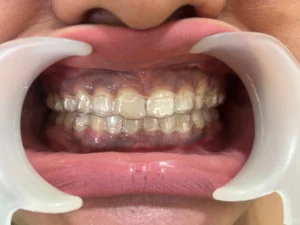
These are specially designed trays that you can wear and remove which help in moving your teeth. At Plexus Dental Studio, we offer Invisible Aligners in Andheri West, Mumbai as a dedicated orthodontic service for patients who prefer a comfortable and nearly invisible treatment option.
They usually come in a set/ sequence of trays Eg: 25 or 35 total trays which you go through sequentially to enable movement of your teeth.
With each subsequent tray, your teeth shift a little by little and eventually achieve a result that you desire.
These treatments are planned digitally and the trays are printed as per your sizing.
As the treatment is digital, you can actually visualize your result before you get started- which works as a great motivator for you. To understand pricing, case eligibility and treatment timelines in detail, you can explore our Clear Aligners Cost in Andheri West guide.
The main advantage of aligners are:
Transparent and not visible to anyone
Very comfortable and easy to adapt
No food restrictions- after removing the trays, you can eat anything without worrying about breaking any wires.
More effective with the timeline and treatment outcome.
However, with aligners, the main requirement is patient discipline because you have to make sure you are wearing the aligners for 18–22 hours a day, only removing them at meal times. This puts the entire treatment in the hands of the patients, unlike some different types of braces that remain fixed on the teeth throughout the treatment period. Maintaining excellent oral hygiene during aligner treatment is important, especially for patients who are prone to cavities or gum issues, as with other different types of braces available in orthodontic care. Related information can be found in our blog on dental care myths vs facts.
Which Type Of Braces Is The Most Comfortable And Least Noticeable?
The most comfortable and least visible braces among the different types of braces are transparent braces or aligners. These provide an almost natural appearance to your teeth and are not visible in photos either. They are very easy to adapt to, and they can be worn and removed singlehandedly without the hassle of food restrictions.
Most adult patients prefer to go with aligners as they are most natural looking and don’t affect their confidence in the workplace. Aligners also do not require monthly visits there by making it easy to fit into your on-the-go schedule. If young adults are also concerned about their looks amongst peers, we recommend they go with aligners. Many patients combine orthodontic treatment with a Smile Makeover in Andheri West for both alignment and aesthetic enhancement.
For young kids at school or teens, they are usually attracted to the concept of braces as they have seen many kids at school with braces and tend to think they look cool. For such patients, it is better to go with braces as they cannot misplace/ lose their aligners. If you’re unsure which option suits your needs, our experienced Dentists in Andheri West can guide you after a detailed orthodontic consultation and digital scan.
How Long Does Treatment Take With Different Types of Braces?
Normally any shifting of teeth requires a minimum of 12 months – 18 months. If the teeth movements are complex and require bite corrections, the treatment time can also go upto 24 months.
Some movements which are easy, eg. small gap closure, 1-2 teeth movements, they require only about 8-10 months.
With aligners, the treatment duration usually depends on the patient’s compliance. If patients are regular with the wearing of aligners, then the treatment gets completed on time and reduces chances of extending.
Are Clear Aligners Better Than Braces?
Both braces and clear aligners serve the same function and promise the same outcome. But the journey is very different for both. Here are some factors to consider before choosing what’s right for you
Go for Braces if you are:
1. Not able to follow the proper discipline of wearing our aligners and changing them as per schedule.
2. If you are likely to lose your aligners or forget where you have kept them.
3. If you are not concerned with the metallic looking smile for a few months and want to make sure you fix your teeth
4. Someone not prone to a lot of cavities and can manage good oral hygiene during the process of your braces.
5. Can keep up with once a month appointment to the dentist.
Go for Aligners if you are:
1. Staying abroad/ outstation- digital treatments are more long term planned and can be monitored over video call.
2. Disciplined enough to incorporate aligner wearing in your schedule.
3. Working/ Business professional- and are conscious of the way you appear in your workplace.
4. Concerned about the metallic look of braces.
5. Do not want to compromise on diet- enjoy eating whatever you like.
6. Someone who has a lot of cavities- much easier to maintain oral hygiene with aligners.
At Plexus Dental Studio, a leading Dental Clinic in Andheri West, we help patients choose the most suitable orthodontic treatment based on their dental condition, lifestyle, and aesthetic preferences.
Different Types of Braces Compared – Fixed vs Removable
| Factor | Fixed Braces (Metal / Ceramic / Lingual) | Clear Aligners |
|---|
| Visibility | Metal: Highly visibleCeramic: Moderately visibleLingual: Not visible | Almost invisible |
| Comfort | Initial discomfort, ulcers possible | Very comfortable |
| Removability | Fixed – cannot be removed | Removable |
| Food Restrictions | Yes (hard & sticky foods avoided) | No restrictions |
| Oral Hygiene | Slightly difficult | Very easy |
| Discipline Required | Low (works regardless of compliance) | High (18–22 hrs/day) |
| Monthly Dental Visits | Mandatory | Fewer visits / remote monitoring |
| Best For | Kids, teens, complex corrections | Adults, working professionals |
| Treatment Duration | 12–24 months | 8–18 months (depends on compliance) |
| Cost Range (India) | ₹55,000 – ₹1,00,000 | ₹1,20,000 – ₹2,50,000 |
What is the cost of Braces in Andheri West?
Braces or aligner treatment is usually carried out over a duration of months, and therefore involves a Full Treatment based cost, not dependent on the number of visits. So when you understand the cost of the treatment, though it might seem more than what you expected, it is important to understand that this cost covers the following:
1. The Orthodontist’s fees
2. The Appliance itself ( either metal/ ceramic brackets + wires OR Removable Aligner trays )
3. All Possible visits you might need throughout your treatment- either planned or emergency.
Here’s a reference chart for cost of braces in india/ cost of aligners in India
Type of braces | Staring cost | Maximum cost |
Metal Braces- Conventional
| Rs. 55,000 | Rs. 60,000 |
Metal Braces- Self Ligating
| Rs. 65,000 | Rs. 70,000 |
Ceramic – Conventional
| Rs. 75,000 | Rs.80,000 |
Ceramic –
Self Ligation
| Rs. 95,000 | Rs. 1,00,000 |
Aligners ( Invisalign Ⓡ)
| Rs. 1,20,000 | Rs. 2,50,000 |
How to Choose Among the Different Types of Braces?
Factors That Can Affect Your Braces Treatment
Here are a few factors which can affect your braces treatment:
Age
Complexity of your teeth correction
Lifestyle
Discipline
While both – Braces or Aligners- can achieve the same goals, it’s important for you to be honest with yourself and your dentist, and then make the choice that best suits your lifestyle. For Braces or Aligners, Age is a no bar and any patient with dental concerns, no matter how old can go for correction of teeth.
At Plexus Dental Studio, we do a thorough examination of your teeth, understand your concerns and goals, consider your lifestyle, and provide multiple options which you can choose from. When deciding amongst braces, there is no best one. The only right option is the one that best works for your teeth, your budget, and your lifestyle. A thorough orthodontic consult, scan and examination can help you understand the different types of braces and the right option for you.
You can also book an appointment for a personalized orthodontic evaluation and smile assessment.