A common dental problem that many people have is missing teeth. Many times because of severe decay or tooth fracture a tooth might require extraction, but what people usually forget or rather underestimate is that a missing tooth requires replacement for improved functional efficiency and to maintain occlusal harmony.
Table of Contents
Why Is Replacing Missing Teeth Important?
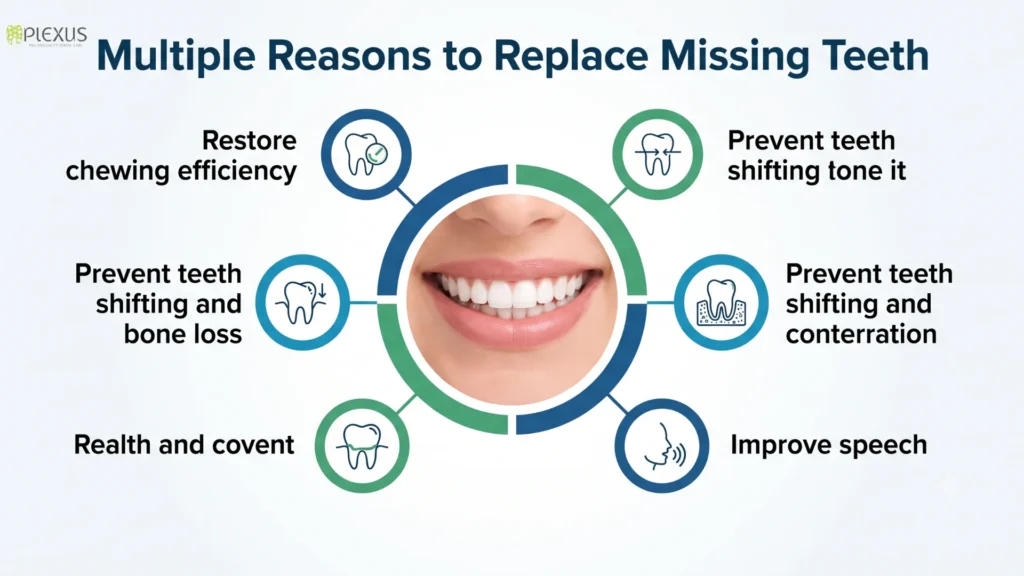
1. Restores Chewing Efficiency
A missing tooth on one side of the jaw usually guides the brain to chew from the other side. This leads to uneven distribution of biting pressures. Multiple missing teeth leads to poor chewing efficiency and therefore indirectly affecting digestion.This can also lead to secondary problems like acid reflux,heart burn etc
2. Prevents Teeth Shifting
Missing teeth which are not replaced leaves an empty space which allows the adjacent and opposing tooth to shift into that space. This shifting of teeth causes crowding, gaps and misalignment of the teeth.All these can lead to food lodgement thus creating a vicious cycle of tooth caries and gum infection.
3. Prevents Bite Problems
Missing teeth causes the opposing tooth to grow into the empty space leading to supraeruption. This supraeruption changes the normal bite. It leads to inefficient chewing and jaw strain. The shifting of the opposing tooth into the empty space also prevents the future possibility of tooth replacement because of space closure.
4. Prevents Jaw Bone Loss
The presence of the tooth root stimulates the jaw bone during chewing. When a tooth is lost, the stimulation provided by it is also lost. This leads to gradual jaw bone loss, eventually making future implant placement difficult.
5. Protects Remaining Teeth
Missing teeth can lead to excessive pressure from chewing on the remaining teeth. The remaining teeth have to bear the extra load. This persistent load over a long period of time can lead to excessive wear,cracks,fracture or even loss of tooth.Replacing the missing teeth distributes the biting forces evenly and thus protects the remaining teeth.
6. Maintains Facial Expressions
Missing teeth over time leads to bone loss which eventually leads to loss of support for the lips and cheeks. This gives a sunken look and makes a person look older in age.
7. Improves Speech
Certain sounds require the proper contact of the tongue and teeth. Missing front tooth can affect the pronunciation and speech clarity which can directly affect one’s confidence.
8. Boosts Confidence
Missing teeth usually leaves a poor impression.Replacing missing teeth restores the natural smile.It improves self-confidence in social and professional situations. For patients looking to enhance both function and aesthetics, a comprehensive smile makeover in Andheri West may also be recommended.
9. Prevents More Expensive Treatment Later
Delayed teeth replacement can lead to teeth movement,bone loss,bite changes, tooth decay and additional dental problems. Early replacement is often simpler,less invasive,more cost-effective and time saving.
Looking for a long-lasting solution to replace missing teeth?
What is a Dental Bridge?
A dental bridge is a customized fixed restoration to replace missing tooth/teeth.A dental bridge takes support on both sides either from natural teeth or implants. A dental bridge consists of 2 parts: a pontic and abutment. A pontic is the part of the dental bridge that replaces the missing tooth and attached to the other crowns of the bridge .The abutments are the adjacent teeth where these crowns will be cemented. A dental bridge replaces the missing tooth, thus restoring the smile and chewing function.
Types Of Dental Bridge
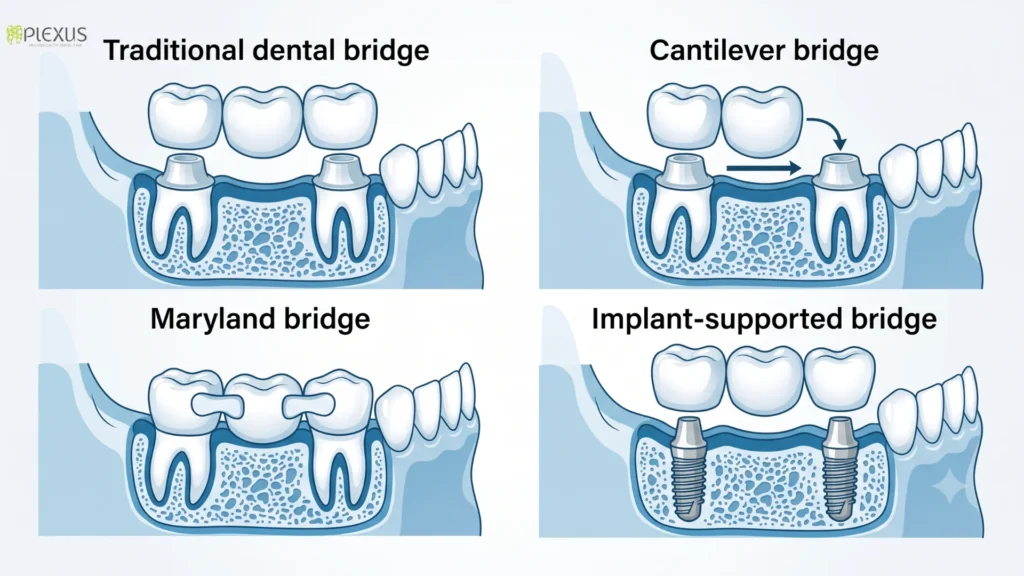
A dental bridge can be divided majorly into 4 types.
1. Traditional Dental Bridge
A Traditional dental bridge has the crowns placed on both sides of the missing tooth by natural teeth. It is usually used to replace one or more missing teeth. When used to replace a single tooth, it provides good strength with predictable prognosis. Since this bridge requires placing dental crowns on natural teeth, neighboring teeth would have to be trimmed for better crown fitting.
2. Cantilever Bridge
Cantilevered bridges are supported on only one tooth ,leaving the other end unsupported. Because of this unsupported bridge, a lever effect is created. Since all the pressure from chewing is transferred on this unsupported bridge, it carries a very high risk for fracture and damage to the supporting tooth. For these reasons, modern dentists avoid cantilever bridges and provide them only for specific cases where no other option is available.
3. Maryland Bridge
Maryland bridge includes a pontic for the missing tooth with two side wing-like extensions that can be bonded to the adjacent teeth. Since the adjacent wings are smaller and placed only on the back surface of the tooth, it requires minimal tooth cutting. Therefore, it is very conservative and aesthetic. Maryland bridges can only be used for front teeth since it cannot handle high biting forces present on the back teeth.
4. Implant Supported Dental Bridge
This consists of a pontic replacing the missing tooth with implants on the adjacent sides. This implant supported dental bridge is a good option for replacing multiple missing teeth. Trimming of the natural teeth is not required as the bridge is implant supported. Thus, protecting the natural teeth and providing a long term solution for missing teeth. Being supported by dental implants in Andheri West, surgical implant placement would be required and the treatment cost would also be higher.
Material Used In Dental Bridge
Porcelain-fused-to-metal (PFM)
PFM crowns/bridges have a ceramic layer coated over a metallic inner core. It is strong and aesthetic ,therefore can be used in the front or back tooth region.
Zirconia
Zirconia is a completely tooth colored, metal-free material with high strength, durability and resistance to crack. It is therefore preferred for back teeth.
All-Ceramic
This is also a metal-free tooth colored material. Because of its high translucency and natural looking appearance, it is preferred for front teeth and is commonly recommended as part of cosmetic dentistry services in Andheri West.
Prices For The Different Types Of Dental Bridge
Traditional 3-Unit Dental Bridge
Depending on the type of material chosen, the price for a traditional 3-unit bridge usually ranges between Rs.15,000/- to Rs.35,000/-. A full metal or PFM bridge are cheaper than Zirconia/all ceramic.
Maryland Bridge
A Maryland bridge can range anywhere between Rs.12,000/- to Rs.20,000/-. It is cheaper than a traditional bridge and therefore provides a budget friendly option for front missing teeth.
Implant-Supported Dental Bridge
This is the most expensive because it includes additional cost for implant placement. Therefore, the total treatment cost starts way higher than the conventional bridge.
Dental Bridge Cost in Andheri West – Price Comparison
| Type of Dental Bridge | Suitable For | Estimated Cost |
|---|---|---|
| Traditional 3-Unit PFM Bridge | Single or multiple missing teeth | ₹15,000 – ₹22,000 |
| Traditional 3-Unit Zirconia Bridge | Front & back teeth | ₹25,000 – ₹35,000 |
| Maryland Bridge | Single missing front tooth | ₹12,000 – ₹20,000 |
| Implant-Supported Bridge | Multiple missing teeth | Starts from ₹60,000* |
Factors That Influence The Bridge Cost
- Number of teeth to be replaced along with the supporting crowns
- Type of material selected- PFM/Zirconia/All ceramic
- Need for additional procedures like implant, root canal,tooth extraction etc.
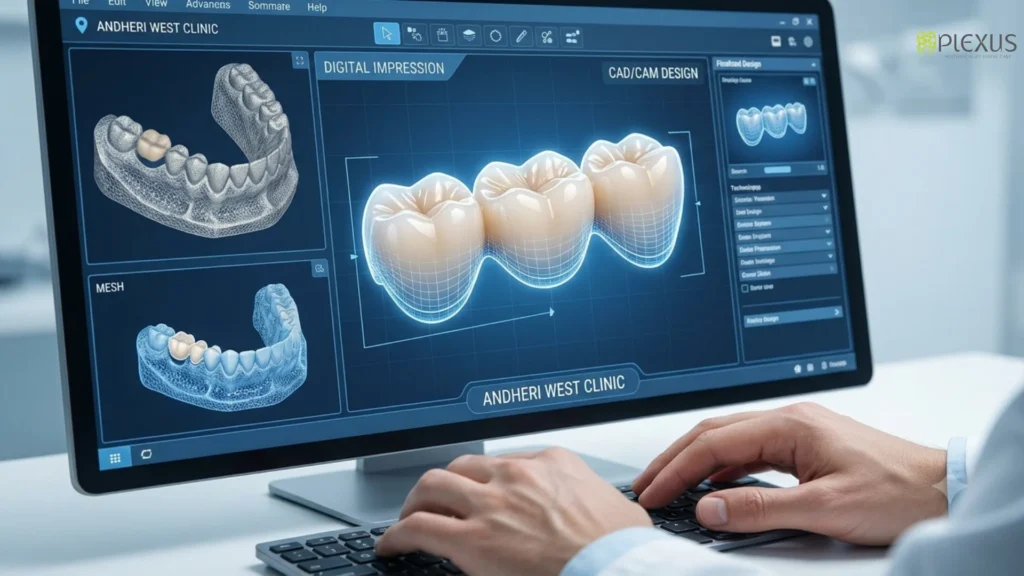
- Doctors’ specialization/experience,Clinic location, technology used- digital impressions, CAD/CAM and lab charges
Why Do Patients Prefer Bridges?
- Unlike removable dentures they are fixed and remain stable.
- Faster than placing individual implants.
- Suitable for patients who cannot undergo surgical placement of implants or have insufficient bone. Budget friendly and effectively restores functionality and aesthetics, making them a valuable option during a comprehensive smile makeover process.
- Budget friendly and effectively restores functionality and aesthetics. If you’re looking for the best dentist in Andheri West, book a consultation at Plexus Dental Studio for a personalized treatment plan and an accurate estimate for your dental bridge treatment.
Restore Your Smile with the Right Dental Bridge
FAQs
How long does it take to complete a bridge?
Once the measurements for the bridge is done with a digital scan or impression, it may take about 5 to 15 working days for the bridge to be placed.
Is a cantilever bridge good?
A cantilever bridge tends to create a lever effect on the supporting teeth. Because of which there is a risk of fracture or damage to the supporting tooth.
Is a bridge better than an implant?
In situations where an implant cannot be placed because of medical conditions or budget-issues then a traditional bridge is an excellent option for replacing missing teeth while maintaining aesthetics and functionality.